For other people named Michael Jordan, see Michael Jordan (disambiguation).
Michael Jordan

Jordan in 2014
|
| Charlotte Hornets |
|---|
| Position | Owner |
|---|
| League | NBA |
|---|
| Personal information |
|---|
| Born | February 17, 1963 (age 52)
Brooklyn, New York |
|---|
| Nationality | American |
|---|
| Listed height | 6 ft 6 in (1.98 m) |
|---|
| Listed weight | 216 lb (98 kg) |
|---|
| Career information |
|---|
| High school | Emsley A. Laney
(Wilmington, North Carolina) |
|---|
| College | North Carolina (1981–1984) |
|---|
| NBA draft | 1984 / Round: 1 / Pick: 3rd overall |
|---|
| Selected by the Chicago Bulls |
| Pro career | 1984–1993, 1995–1998, 2001–2003 |
|---|
| Position | Shooting guard / Small forward |
|---|
| Number | 23, 45, 12[a] |
|---|
| Career history |
|---|
| 1984–1993,1995–1998 | Chicago Bulls |
|---|
| 2001–2003 | Washington Wizards |
|---|
| Career highlights and awards |
|---|
- 6× NBA champion (1991–1993, 1996–1998)
- 6× NBA Finals MVP (1991–1993, 1996–1998)
- 5× NBA Most Valuable Player (1988, 1991–1992,1996, 1998)
- 14× NBA All-Star (1985–1993, 1996–1998,2002–2003)
- 3× NBA All-Star Game MVP (1988, 1996, 1998)
- 10× All-NBA First Team (1987–1993, 1996–1998)
- All-NBA Second Team (1985)
- NBA Defensive Player of the Year (1988)
- 9× NBA All-Defensive First Team (1988–1993,1996–1998)
- NBA Rookie of the Year (1985)
- NBA All-Rookie First Team (1985)
- 10× NBA scoring champion (1987–1993,1996–1998)
- 3× NBA steals champion (1988, 1990, 1993)
- 2× NBA Slam Dunk Contest champion (1987–1988)
- All-Time NBA playoff leading scorer
- Chicago Bulls all-time leading scorer
- No. 23 retired by Chicago Bulls
- No. 23 retired by Miami Heat
- 3x AP Athlete of the Year (1991, 1992, 1993)
- 2x USA Basketball Male Athlete of the Year (1983–1984)
- NBA's 50th Anniversary All-Time Team
- NCAA champion (1982)
- 2× Consensus first-team All-American (1983–1984)
- National college player of the year (1984)
- ACC Player of the Year (1984)
- No. 23 retired by North Carolina
|
| Career statistics |
|---|
| Points | 32,292 (30.1 ppg) |
|---|
| Rebounds | 6,672 (6.2 rpg) |
|---|
| Assists | 5,633 (5.3 apg) |
|---|
| Stats at Basketball-Reference.com |
|
| Basketball Hall of Fame as player |
|
|
|---|
Michael Jeffrey Jordan (born February 17, 1963), also known by his initials, MJ,[1] is an American former professionalbasketball player. He is also an entrepreneur, and principal owner and chairman of the Charlotte Hornets. Jordan played 15 seasons in the National Basketball Association (NBA) for the Chicago Bulls and Washington Wizards. His biography on the NBA website states: "By acclamation, Michael Jordan is the greatest basketball player of all time."[2] Jordan was one of the most effectively marketed athletes of his generation and was considered instrumental in popularizing the NBA around the world in the 1980s and 1990s.[3]
After a three-season stint at the University of North Carolina, where he was a member of the Tar Heels' national championship team in 1982, Jordan joined the NBA's Chicago Bulls in 1984. He quickly emerged as a league star, entertaining crowds with his prolific scoring. His leaping ability, illustrated by performing slam dunks from the free throw line inslam dunk contests, earned him the nicknames "Air Jordan" and "His Airness". He also gained a reputation for being one of the best defensive players in basketball.[4] In 1991, he won his first NBA championship with the Bulls, and followed that achievement with titles in 1992 and 1993, securing a "three-peat". Although Jordan abruptly retired from basketball before the beginning of the 1993–94 NBA season to pursue a career in baseball, he returned to the Bulls in March 1995 and led them to three additional championships in 1996, 1997, and 1998, as well as an NBA-record 72 regular-season wins in the 1995–96 NBA season. Jordan retired for a second time in January 1999, but returned for two more NBA seasons from 2001 to 2003 as a member of the Wizards.
Jordan's individual accolades and accomplishments include five Most Valuable Player (MVP) Awards, ten All-NBA First Team designations, nine All-Defensive First Team honors, fourteen NBA All-Star Game appearances, three All-Star Game MVP Awards, ten scoring titles, three steals titles, six NBA Finals MVP Awards, and the 1988 NBA Defensive Player of the Year Award. Among his numerous accomplishments, Jordan holds the NBA records for highest career regular season scoring average (30.12 points per game) and highest career playoff scoring average (33.45 points per game). In 1999, he was named the greatest North American athlete of the 20th century by ESPN, and was second to Babe Ruth on the Associated Press's list of athletes of the century. Jordan is a two-time inductee into the Basketball Hall of Fame, having been enshrined in 2009 for his individual career, and again in 2010 as part of the group induction of the 1992 United States men's Olympic basketball team ("The Dream Team").
Jordan is also known for his product endorsements. He fueled the success of Nike's Air Jordan sneakers, which were introduced in 1985 and remain popular today.[5] Jordan also starred in the 1996 feature film Space Jam as himself. In 2006, he became part-owner and head of basketball operations for the then-Charlotte Bobcats, buying controlling interest in 2010. In 2015, Jordan became the first athlete in history to become a billionaire, according to Forbes.[6]
Contents
[hide]
- 1 Early years
- 2 High school
- 3 College
- 4 Professional career
- 4.1 Early NBA years (1984–1987)
- 4.2 Pistons roadblock (1987–1990)
- 4.3 First three-peat (1991–1993)
- 4.4 First retirement and baseball career (1993–1994)
- 4.5 "I'm back": Return to the NBA (1995)
- 4.6 Second three-peat (1995–1998)
- 4.7 Second retirement (1999–2001)
- 4.8 Washington Wizards comeback (2001–2003)
- 5 Olympic career
- 6 Post-retirement
- 6.1 Charlotte Bobcats/Hornets
- 7 Player profile
- 8 NBA career statistics
- 8.1 Regular season
- 8.2 Playoffs
- 9 Legacy
- 10 Personal life
- 11 Media figure and business interests
- 12 Awards and honors
- 13 See also
- 14 Notes
- 15 References
- 16 Sources
- 17 Further reading
- 18 External links
Early years
Jordan was born in Brooklyn, New York, the son of Deloris (née Peoples), who worked in banking, and James R. Jordan, Sr., an equipment supervisor. His family moved to Wilmington, North Carolina, when he was a toddler.[7]
Jordan is the fourth of five children. He has two older brothers, Larry Jordan and James R. Jordan, Jr., one older sister, Deloris, and a younger sister, Roslyn. Jordan's brother James retired in 2006 as the Command Sergeant Major of the 35th Signal Brigade of the XVIII Airborne Corps in the U.S. Army.[8]
High school

Jordan playing for the Laney High School varsity basketball team in 1979-80.
Jordan attended Emsley A. Laney High School in Wilmington, where he anchored his athletic career by playing baseball,football, and basketball. He tried out for the varsity basketball team during his sophomore year, but at 5'11" (1.80 m), he was deemed too short to play at that level. His taller friend, Harvest Leroy Smith, was the only sophomore to make the team.[9]
Motivated to prove his worth, Jordan became the star of Laney's junior varsity squad, and tallied several 40-point games.[9]The following summer, he grew four inches (10 cm)[2] and trained rigorously. Upon earning a spot on the varsity roster, Jordan averaged about 20 points per game over his final two seasons of high school play.[10][11] As a senior, he was selected to the McDonald's All-American Team[12] after averaging a triple-double: 29.2 points, 11.6 rebounds, and 10.1 assists.[13]
Jordan was recruited by numerous college basketball programs, including Duke, North Carolina, South Carolina, Syracuse, and Virginia.[14] In 1981, Jordan accepted a basketball scholarship to North Carolina, where he majored in cultural geography.[15]
College

Michael Jordan's jersey in the rafters of The Dean Smith Center
As a freshman in coach Dean Smith's team-oriented system, he was named ACC Freshman of the Year after he averaged 13.4 points per game (ppg) on 53.4% shooting (field goal percentage).[16] He made the game-winning jump shot in the 1982 NCAA Championship game against Georgetown, which was led by future NBA rival Patrick Ewing.[2] Jordan later described this shot as the major turning point in his basketball career.[17] During his three seasons at North Carolina, he averaged 17.7 ppg on 54.0% shooting, and added 5.0 rebounds per game (rpg).[10]He was selected by consensus to the NCAA All-American First Team in both his sophomore (1983) and junior (1984) seasons. After winning the Naismith and the Wooden College Player of the Year awards in 1984, Jordan left North Carolina one year before his scheduled graduation to enter the 1984 NBA draft. The Chicago Bullsselected Jordan with the third overall pick, after Hakeem Olajuwon (Houston Rockets) and Sam Bowie (Portland Trail Blazers). One of the primary reasons why Jordan was not drafted sooner was because the first two teams were in need of a center.[18] However, the Trail Blazers general manager Stu Inman contended that it was not a matter of drafting a center, but more a matter of taking Sam Bowie over Jordan, in part because Portland already had a guard with similar skills to Jordan, Clyde Drexler.[19] In 2005 ESPN, citing Bowie's injury-laden college career, named the Blazers' choice of Bowie as the worst draft pick in North American professional sports history.[20] Jordan returned to North Carolina to complete his degree in 1986.[21]
Professional career
Early NBA years (1984–1987)
During his first season in the NBA, Jordan averaged 28.2 ppg on 51.5% shooting.[16] He quickly became a fan favorite even in opposing arenas,[22][23][24] and appeared on the cover of Sports Illustrated with the heading "A Star Is Born" just over a month into his professional career.[25][26] Jordan was also voted in as an All-Star starter by the fans in his rookie season.[2] Controversy arose before the All-Star game when word surfaced that several veteran players, led by Isiah Thomas, were upset by the amount of attention Jordan was receiving.[2] This led to a so-called "freeze-out" on Jordan, where players refused to pass him the ball throughout the game.[2] The controversy left Jordan relatively unaffected when he returned to regular season play, and he would go on to be voted Rookie of the Year.[27] The Bulls finished the season 38–44,[28] and lost in the first round of the playoffs in four games to the Milwaukee Bucks.[27]
Jordan's second season was cut short by a broken foot in the third game of the season, which caused him to miss 64 games.[2] Despite Jordan's injury and a 30–52 record (at the time it was fifth worst record of any team to qualify for the playoffs in NBA history),[28][29] the Bulls made the playoffs. Jordan recovered in time to participate in the playoffs and performed well upon his return. Against a 1985–86 Boston Celtics team that is often considered one of the greatest in NBA history,[30] Jordan set the still-unbroken record for points in a playoff game with 63 in Game 2.[31] The Celtics, however, managed to sweep the series.[27]
Jordan had recovered completely by the 1986–87 season, and had one of the most prolific scoring seasons in NBA history. He became the only player other than Wilt Chamberlain to score 3,000 points in a season, averaging a league high 37.1 points on 48.2% shooting.[16] In addition, Jordan demonstrated his defensive prowess, as he became the first player in NBA history to record 200 steals and 100 blocks in a season.[32] Despite Jordan's success, Magic Johnson won the league's Most Valuable Player Award. The Bulls reached 40 wins,[28] and advanced to the playoffs for the third consecutive year. However, they were again swept by the Celtics.[27]
Pistons roadblock (1987–1990)
Jordan led the league in scoring again in the 1987–88 season, averaging 35.0 ppg on 53.5% shooting[16] and won his first league MVP Award. He was also named the Defensive Player of the Year, as he had averaged 1.6 blocks and a league high 3.16 steals per game.[33]The Bulls finished 50–32,[28] and made it out of the first round of the playoffs for the first time in Jordan's career, as they defeated theCleveland Cavaliers in five games.[34] However, the Bulls then lost in five games to the more experienced Detroit Pistons,[27] who were led by Isiah Thomas and a group of physical players known as the "Bad Boys".
In the 1988–89 season, Jordan again led the league in scoring, averaging 32.5 ppg on 53.8% shooting from the field, along with 8 rpg and 8 assists per game (apg).[16] The Bulls finished with a 47–35 record,[28] and advanced to the Eastern Conference Finals, defeating theCavaliers and New York Knicks along the way. The Cavaliers series included a career highlight for Jordan when he hit The Shot overCraig Ehlo at the buzzer in the fifth and final game of the series.[35] However, the Pistons again defeated the Bulls, this time in six games,[27] by utilizing their "Jordan Rules" method of guarding Jordan, which consisted of double and triple teaming him every time he touched the ball.[2]
The Bulls entered the 1989–90 season as a team on the rise, with their core group of Jordan and young improving players like Scottie Pippen and Horace Grant, and under the guidance of new coach Phil Jackson. Jordan averaged a league leading 33.6 ppg on 52.6% shooting, to go with 6.9 rpg and 6.3 apg[16] in leading the Bulls to a 55–27 record.[28]They again advanced to the Eastern Conference Finals beating the Bucks and Philadelphia 76ers. However, despite pushing the series to seven games, the Bulls lost to thePistons for the third consecutive season.[27]
First three-peat (1991–1993)
In the 1990–91 season, Jordan won his second MVP award after averaging 31.5 ppg on 53.9% shooting, 6.0 rpg, and 5.5 apg for the regular season.[16] The Bulls finished in first place in their division for the first time in 16 years and set a franchise record with 61 wins in the regular season.[28] With Scottie Pippen developing into an All-Star, the Bulls had elevated their play. The Bulls defeated the New York Knicks and the Philadelphia 76ers in the opening two rounds of the playoffs. They advanced to the Eastern Conference Finals where their rival, the Detroit Pistons, awaited them. However, this time the Bulls beat the Pistons in a four-game sweep.[36][37] In an unusual ending to the fourth and final game, Isiah Thomas led his team off the court before the final seconds had concluded. Most of the Pistons went directly to their locker room instead of shaking hands with the Bulls.[38][39]
The Bulls advanced to the NBA Finals for the first time in franchise history to face Magic Johnson and James Worthy and beat the Los Angeles Lakers four games to one, compiling an outstanding 15–2 playoff record along the way.[36] Perhaps the best known moment of the series came in Game 2 when, attempting a dunk, Jordan avoided a potential Sam Perkins block by switching the ball from his right hand to his left in mid-air to lay the shot in.[40] In his first Finals appearance, Jordan posted per game averages of 31.2 points on 56% shooting from the field, 11.4 assists, 6.6 rebounds, 2.8 steals and 1.4 blocks.[41] Jordan won his first NBA Finals MVP award,[42] and he cried while holding the NBA Finals trophy.[43]
Jordan and the Bulls continued their dominance in the 1991–92 season, establishing a 67–15 record, topping their franchise record from 1990 to 91.[28] Jordan won his second consecutive MVP award with averages of 30.1 points, 6.4 rebounds and 6.1 assists per game on 52% shooting.[33] After winning a physical 7-game series over the New York Knicks in the second round of the playoffs and finishing off the Cleveland Cavaliers in the Conference Finals in 6 games, the Bulls met Clyde Drexler and the Portland Trail Blazers in the Finals. The media, hoping to recreate a Magic–Bird rivalry, highlighted the similarities between "Air" Jordan and Clyde "The Glide" during the pre-Finals hype.[44] In the first game, Jordan scored a Finals-record 35 points in the first half, including a record-setting six three-point field goals.[45] After the sixth three-pointer, he jogged down the court shrugging as he looked courtside. Marv Albert, who broadcast the game, later stated that it was as if Jordan was saying, "I can't believe I'm doing this."[46] The Bulls went on to win Game 1, and defeat the Blazers in six games. Jordan was named Finals MVP for the second year in a row[42] and finished the series averaging 35.8 ppg, 4.8 rpg, and 6.5 apg, while shooting 53% from the floor.[42]
In the 1992–93 season, despite a 32.6 ppg, 6.7 rpg and 5.5 apg campaign,[33] Jordan's streak of consecutive MVP seasons ended as he lost the award to his friend Charles Barkley. Coincidentally, Jordan and the Bulls met Barkley and his Phoenix Suns in the 1993 NBA Finals. The Bulls won their third NBA championship on a game-winning shot byJohn Paxson and a last-second block by Horace Grant, but Jordan was once again Chicago's leader. He averaged a Finals-record 41.0 ppg during the six-game series,[47] and became the first player in NBA history to win three straight Finals MVP awards.[42] He scored more than 30 points in every game of the series, including 40 or more points in 4 consecutive games. With his third Finals triumph, Jordan capped off a seven-year run where he attained seven scoring titles and three championships, but there were signs that Jordan was tiring of his massive celebrity and all of the non-basketball hassles in his life.[48]
Gambling controversy
During the Bulls' playoff run in 1993, controversy arose when Jordan was seen gambling in Atlantic City, New Jersey, the night before a game against the New York Knicks.[49] In that same year, he admitted to having to cover $57,000 in gambling losses,[50] and author Richard Esquinas wrote a book claiming he had won $1.25 million from Jordan on the golf course.[50] In 2005, Jordan talked to Ed Bradley of the CBS evening show 60 Minutes about his gambling and admitted that he made some reckless decisions. Jordan stated, "Yeah, I've gotten myself into situations where I would not walk away and I've pushed the envelope. Is that compulsive? Yeah, it depends on how you look at it. If you're willing to jeopardize your livelihood and your family, then yeah."[51] When Bradley asked him if his gambling ever got to the level where it jeopardized his livelihood or family, Jordan replied, "No."[51]
First retirement and baseball career (1993–1994)
| Michael Jordan |
|---|
| Birmingham Barons – No. 45 & No. 35 |
|---|
| Outfielder |
| Batted: Right | Threw: Right |
|
| Professional debut |
|---|
| Southern League: April 8, 1994, for the Birmingham Barons |
| Arizona Fall League: 1994 for the Scottsdale Scorpions |
| Last professional appearance |
|---|
| Southern League: March 10, 1995, for the Birmingham Barons |
Southern League statistics
(through 1994) |
|---|
| Batting average | .202 |
|---|
| Home runs | 3 |
|---|
| Runs batted in | 51 |
|---|
| Arizona Fall League statistics |
|---|
| Batting average | .252 |
|---|
| Teams |
|---|
- Birmingham Barons (1994–1995)
- Scottsdale Scorpions (1994)
|

Michael Jordan while playing with the Scottsdale Scorpions
On October 6, 1993, Jordan announced his retirement, citing a loss of desire to play the game. Jordan later stated that the murder of his father earlier in the year also shaped his decision.[52]Jordan's father was murdered on July 23, 1993, at a highway rest area in Lumberton, North Carolina, by two teenagers, Daniel Green and Larry Martin Demery. The assailants were traced from calls they made on James Jordan's cellular phone,[53] caught, convicted, and sentenced to life in prison. Jordan was close to his father; as a child he had imitated his father's proclivity to stick out his tongue while absorbed in work. He later adopted it as his own signature, displaying it each time he drove to the basket.[2] In 1996, he founded a Chicago area Boys & Girls Club and dedicated it to his father.[54][55]
In his 1998 autobiography For the Love of the Game, Jordan wrote that he had been preparing for retirement as early as the summer of 1992.[56] The added exhaustion due to the Dream Team run in the 1992 Olympics solidified Jordan's feelings about the game and his ever-growing celebrity status. Jordan's announcement sent shock waves throughout the NBA and appeared on the front pages of newspapers around the world.[57]
Jordan then further surprised the sports world by signing a minor league baseball contract with the Chicago White Sox on February 7, 1994.[58] He reported to spring training in Sarasota, Florida, and was assigned to the team's minor league system on March 31, 1994.[59] Jordan has stated this decision was made to pursue the dream of his late father, who had always envisioned his son as aMajor League Baseball player.[60] The White Sox were another team owned by Bulls owner Jerry Reinsdorf, who continued to honor Jordan's basketball contract during the years he played baseball.[61] In 1994, Jordan played for the Birmingham Barons, a Double-A minor league affiliate of the Chicago White Sox, batting .202 with three home runs, 51 runs batted in, 30 stolen bases, and 11errors.[11] He also appeared for the Scottsdale Scorpions in the 1994 Arizona Fall League, batting .252 against the top prospects in baseball.[62] On November 1, 1994, his number 23 was retired by the Bulls in a ceremony that included the erection of a permanent sculpture known as The Spirit outside the new United Center.[63][64][65]
"I'm back": Return to the NBA (1995)
In the 1993–94 season, the Bulls, without Jordan, achieved a 55–27 record,[28] and lost to the New York Knicks in the second round of the playoffs. But the 1994–95 Bulls were a shell of the championship team of just two years earlier. Struggling at mid-season to ensure a spot in the playoffs, Chicago was 31–31 at one point in mid-March.[66] The team received help, however, when Jordan decided to return to the NBA for the Bulls.
In March 1995, Jordan decided to quit baseball due to the ongoing Major League Baseball strike, as he wanted to avoid becoming a potential replacement player.[67] On March 18, 1995, Jordan announced his return to the NBA through a two-word press release: "I'm back."[2] The next day, Jordan wore jersey number 45 (his number with the Barons), as his familiar 23 had been retired in his honor following his first retirement. He took to the court with the Bulls to face the Indiana Pacers in Indianapolis, scoring 19 points.[68] The game had the highest Nielsen rating of a regular season NBA game since 1975.[69]
Although he had not played an NBA game in a year and a half, Jordan played well upon his return, making a game-winning jump shot against Atlanta in his fourth game back. He then scored 55 points in the next game against the Knicks at Madison Square Garden on March 28, 1995.[27] Boosted by Jordan's comeback, the Bulls went 13–4 to make the playoffs and advanced to the Eastern Conference Semifinals against the Orlando Magic. At the end of Game 1, Orlando's Nick Anderson stripped Jordan from behind, leading to the game-winning basket for the Magic; he would later comment that Jordan "didn't look like the old Michael Jordan"[70] and that "No. 45 doesn't explode like No. 23 used to." Jordan then returned to wearing his old number in the next game, scoring 38 points in a Bulls win. The Bulls were fined $30,000 for the game: $25,000 for failing to report the impromptu number change to the NBA and $5,000 for Jordan wearing different shoes.[71] Jordan averaged 31 points per game in the series, but Orlando won the series in 6 games.[10]
Second three-peat (1995–1998)
Freshly motivated by the playoff defeat, Jordan trained aggressively for the 1995–96 season.[72] Strengthened by the addition of rebound specialist Dennis Rodman, the Bulls dominated the league, starting the season 41–3,[73] and eventually finishing with the best regular season record in NBA history: 72–10.[30] Jordan led the league in scoring with 30.4 ppg,[74] and won the league's regular season and All-Star Game MVP awards.[2] In the playoffs, the Bulls lost only three games in four series, defeating the Seattle SuperSonics in the NBA Finals to win their fourth championship. Jordan was named Finals MVP for a record fourth time,[42] surpassing Magic Johnson's three Finals MVP awards. He also achieved only the second sweep of the MVP Awards in the All-Star Game, regular season and NBA Finals, Willis Reed having achieved the first, during the1969–70 season.[27] Because this was Jordan's first championship since his father's murder, and it was won on Father's Day, Jordan reacted very emotionally upon winning the title, including a memorable scene of him crying on the locker room floor with the game ball.[2][43]
In the 1996–97 season, the Bulls started out 69–11, but narrowly missed out on a second consecutive 70-win season by losing their final two games to finish 69–13.[75] However, this year Jordan was beaten for the NBA MVP Award by Karl Malone. The Bulls again advanced to the Finals, where they faced Malone and the Utah Jazz. The series against the Jazz featured two of the more memorable clutch moments of Jordan's career. He won Game 1 for the Bulls with a buzzer-beating jump shot. In Game 5, with the series tied at 2, Jordan played despite being feverish and dehydrated from a stomach virus. In what is known as the "Flu Game", Jordan scored 38 points, including the game-deciding 3-pointer with 25 seconds remaining.[76] The Bulls won 90–88 and went on to win the series in six games.[75] For the fifth time in as many Finals appearances, Jordan received the Finals MVP award.[42] During the 1997 NBA All-Star Game, Jordan posted the first triple double in All-Star Game history in a victorious effort; however, he did not receive the MVP award.

Jordan with coach Phil Jackson in 1997
Jordan and the Bulls compiled a 62–20 record in the 1997–98 season.[28] Jordan led the league with 28.7 points per game,[33] securing his fifth regular-season MVP award, plus honors for All-NBA First Team, First Defensive Team and the All-Star Game MVP.[2] The Bulls won the Eastern Conference Championship for a third straight season, including surviving a grueling seven-game series with Reggie Miller's Indiana Pacers in the Eastern Conference Finals; it was the first time Jordan had played in a Game 7 since the 1992 series with the Knicks. After winning, they moved on for a rematch with the Jazz in the Finals.
The Bulls returned to the Delta Center for Game 6 on June 14, 1998, leading the series 3–2. Jordan executed a series of plays, considered to be one of the greatest clutch performances in NBA Finals history.[77] With the Bulls trailing 86–83 with 41.9 seconds remaining, Phil Jackson called a timeout. When play resumed, Jordan received the inbound pass, drove to the basket, and hit a shot over several Jazz defenders, cutting the Utah lead to 86–85.[77] The Jazz brought the ball upcourt and passed the ball to forward Karl Malone, who was set up in the low post and was being guarded by Rodman. Malone jostled with Rodman and caught the pass, but Jordan cut behind him and stole the ball out of his hands for a steal.[77] Jordan then slowly dribbled down the court and paused at the top of the key, eyeing his defender, Jazz guard Bryon Russell. With 10 seconds remaining, Jordan started to dribble right, then crossed over to his left, possibly pushing off Russell,[78][79][80] although the officials did not call a foul. With 5.2 seconds left, Jordan gave Chicago an 87–86 lead by making the climactic jump shot of his career. After John Stockton missed a desperation three-pointer, Jordan and the Bulls won their sixth NBA championship, and secured a second three-peat. Once again, Jordan was voted the Finals MVP,[42] having led all scorers by averaging 33.5 points per game, including 45 in the deciding Game 6.[81] Jordan's six Finals MVPs is a record; Shaquille O'Neal, Magic Johnson, and Tim Duncan are tied for second place with three apiece.[42] The 1998 Finals holds the highest television rating of any Finals series in history, and Game 6 holds the highest television rating of any game in NBA history.[82][83]
Second retirement (1999–2001)
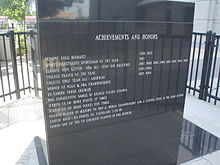
Plaque at the United Center chronicling Jordan's career achievements.
With Phil Jackson's contract expiring, the pending departures of Scottie Pippen (who stated his desire to be traded during the offseason) and Dennis Rodman (who would sign with the Los Angeles Lakers as a free agent) looming, and being in the latter stages of an owner-induced lockout of NBA players, Jordan retired for the second time on January 13, 1999.
On January 19, 2000, Jordan returned to the NBA not as a player, but as part owner and President of Basketball Operations for theWashington Wizards.[84] Jordan's responsibilities with the Wizards were comprehensive. He controlled all aspects of the Wizards' basketball operations, and had the final say in all personnel matters. Opinions of Jordan as a basketball executive were mixed.[85][86] He managed to purge the team of several highly paid, unpopular players (such as forward Juwan Howard and point guard Rod Strickland),[87][88] but used the first pick in the 2001 NBA draft to select high schooler Kwame Brown, who did not live up to expectations and was traded away after four seasons.[85][89]
Despite his January 1999 claim that he was "99.9% certain" that he would never play another NBA game,[43] in the summer of 2001 Jordan expressed interest in making another comeback,[90][91] this time with his new team. Inspired by the NHL comeback of his friendMario Lemieux the previous winter,[92] Jordan spent much of the spring and summer of 2001 in training, holding several invitation-only camps for NBA players in Chicago.[93] In addition, Jordan hired his old Chicago Bulls head coach, Doug Collins, as Washington's coach for the upcoming season, a decision that many saw as foreshadowing another Jordan return.[90][91]
Washington Wizards comeback (2001–2003)

Jordan as a member of the Washington Wizards on April 14, 2003
On September 25, 2001, Jordan announced his return to the NBA to play for the Washington Wizards, indicating his intention to donate his salary as a player to a relief effort for the victims of the September 11, 2001 attacks.[94][95] In an injury-plagued 2001–02 season, he led the team in scoring (22.9 ppg), assists (5.2 apg), and steals (1.42 spg).[2] However, torn cartilage in his right knee ended Jordan's season after only 60 games, the fewest he had played in a regular season since playing 17 games after returning from his first retirement during the 1994–95 season.[16]
Playing in his 14th and final NBA All-Star Game in 2003, Jordan passed Kareem Abdul-Jabbar as the all-time leading scorer in All-Star Game history (a record since broken by Kobe Bryant).[96] That year, Jordan was the only Washington player to play in all 82 games, starting in 67 of them. He averaged 20.0 points, 6.1 rebounds, 3.8 assists, and 1.5 steals per game.[2] He also shot 45% from the field, and 82% from the free throw line.[2] Even though he turned 40 during the season, he scored 20 or more points 42 times, 30 or more points nine times, and 40 or more points three times.[27] On February 21, 2003, Jordan became the first 40-year-old to tally 43 points in an NBA game.[97] During his stint with the Wizards, all of Jordan's home games at the MCI Center were sold out, and the Wizards were the second most-watched team in the NBA, averaging 20,172 fans a game at home and 19,311 on the road.[98] However, neither of Jordan's final two seasons resulted in a playoff appearance for the Wizards, and Jordan was often unsatisfied with the play of those around him.[99][100] At several points he openly criticized his teammates to the media, citing their lack of focus and intensity, notably that of the number one draft pick in the 2001 NBA draft, Kwame Brown.[99][100]
With the recognition that 2002–03 would be Jordan's final season, tributes were paid to him throughout the NBA. In his final game at his old home court, the United Center in Chicago, Jordan received a four-minute standing ovation.[101] The Miami Heat retired the number 23 jersey on April 11, 2003, even though Jordan never played for the team.[102]At the 2003 All-Star Game, Jordan was offered a starting spot from Tracy McGrady and Allen Iverson,[103] but refused both. In the end he accepted the spot of Vince Carter, who decided to give it up under great public pressure.[104]
Jordan's final NBA game was on April 16, 2003 in Philadelphia. After scoring only 13 points in the game, Jordan went to the bench with 4 minutes and 13 seconds remaining in the third quarter and with his team trailing the Philadelphia 76ers, 75–56. Just after the start of the fourth quarter, the First Union Center crowd began chanting "We want Mike!". After much encouragement from coach Doug Collins, Jordan finally rose from the bench and re-entered the game, replacing Larry Hughes with 2:35 remaining. At 1:45, Jordan was intentionally fouled by the 76ers' Eric Snow, and stepped to the line to make both free throws. After the second foul shot, the 76ers in-bounded the ball to rookie John Salmons, who in turn was intentionally fouled by Bobby Simmons one second later, stopping time so that Jordan could return to the bench. Jordan received a three-minute standing ovation from his teammates, his opponents, the officials and the crowd of 21,257 fans.[105]
Olympic career

Jordan on the "Dream Team" in 1992
Jordan played on two Olympic gold medal-winning American basketball teams. As a college player he participated, and won the gold, in the 1984 Summer Olympics. The team was coached by Bob Knight and featured players such as Patrick Ewing, Sam Perkins, Chris Mullin, Steve Alford, and Wayman Tisdale. Jordan led the team in scoring, averaging 17.1 ppg for the tournament.[106]
In the 1992 Summer Olympics, he was a member of the star-studded squad that included Magic Johnson, Larry Bird, and David Robinsonand was dubbed the "Dream Team". Jordan was the only player to start all 8 games in the Olympics. Playing limited minutes due to the frequent blowouts, Jordan averaged 14.9 ppg,[107] finishing second on the team in scoring.[108] Jordan and fellow Dream Team membersPatrick Ewing and Chris Mullin are the only American men's basketball players to win Olympic gold as amateurs and professionals.[106][107]
Post-retirement
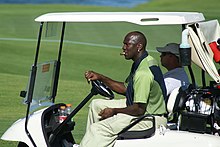
Jordan on a golf course in 2007
After his third retirement, Jordan assumed that he would be able to return to his front office position of Director of Basketball Operations with the Wizards.[109] However, his previous tenure in the Wizards' front office had produced the aforementioned mixed results and may have also influenced the trade of Richard "Rip" Hamilton for Jerry Stackhouse (although Jordan was not technically Director of Basketball Operations in 2002).[85] On May 7, 2003, Wizards owner Abe Pollin fired Jordan as Washington's President of Basketball Operations.[85] Jordan later stated that he felt betrayed, and that if he knew he would be fired upon retiring he never would have come back to play for the Wizards.[51]
Jordan kept busy over the next few years by staying in shape, playing golf in celebrity charity tournaments, spending time with his family in Chicago, promoting his Jordan Brand clothing line, and riding motorcycles.[110] Since 2004, Jordan has owned Michael Jordan Motorsports, a professional closed-course motorcycle road racing team that competes with two Suzukis in the premier Superbike class sanctioned by the American Motorcyclist Association (AMA).[111][112] Jordan and his then-wife Juanita pledged $5 million to Chicago's Hales Franciscan High School in 2006,[113]and the Jordan Brand has made donations to Habitat for Humanity and a Louisiana branch of the Boys & Girls Clubs of America.[114]
Charlotte Bobcats/Hornets
On June 15, 2006, Jordan bought a minority stake in the Charlotte Bobcats, becoming the team's second-largest shareholder behind majority owner Robert L. Johnson. As part of the deal, Jordan took full control over the basketball side of the operation, with the title "Managing Member of Basketball Operations."[115] Despite Jordan's previous success as an endorser, he has made an effort not to be included in Charlotte's marketing campaigns.[116] A decade earlier, Jordan had made a bid to become part-owner of Charlotte's original NBA team, the Charlotte Hornets, but talks collapsed when owner George Shinn refused to give Jordan complete control of basketball operations.[117]
In February 2010, it was reported that Jordan was seeking majority ownership of the Bobcats.[118] As February wore on, it emerged that the leading contenders for the team were Jordan and former Houston Rockets president George Postolos. On February 27, the Bobcats announced that Johnson had reached an agreement with Jordan and his group, MJ Basketball Holdings, to buy the team pending NBA approval.[119] On March 17, the NBA Board of Governors unanimously approved Jordan's purchase, making him the first former player ever to become the majority owner of an NBA team.[120] It also made him the league's only African-American majority owner.[121]

Jordan in 2014, during the NBA's board of governors meeting
During the 2011 NBA lockout, The New York Times wrote that Jordan led a group of 10 to 14 hardline owners wanting to cap the players' share of basketball-related income at 50 percent and as low as 47. Journalists observed that, during the labor dispute in 1998, Jordan had told Washington Wizards then-owner Abe Pollin, "If you can't make a profit, you should sell your team."[122] Jason Whitlock of FoxSports.com called Jordan a "sellout" wanting "current players to pay for his incompetence."[123] He cited Jordan's executive decisions to draft disappointing players Kwame Brown and Adam Morrison.[123]
During the 2011–12 NBA season, which was shortened to 66 games, the Bobcats posted a 7–59 record. Their .106 winning percentage was the worst in NBA history.[124] "I'm not real happy about the record book scenario last year. It's very, very frustrating," Jordan said later that year.[125]
On May 21, 2013, Jordan filed papers to change the Bobcats' name to the Hornets, effective with the 2014–15 season. The Hornets name had become available when the original Hornets, who had moved to New Orleans in 2002, changed their name to the New Orleans Pelicans for the 2013–14 season.[126] The NBA approved the change on July 18.[127] The name change became official on May 20, 2014. On the same day, the team announced that it had reclaimed the history and records of the original 1988–2002 Hornets.[128]
Player profile

Jordan goes to the basket for a score in 1997.
Jordan was a shooting guard who was also capable of playing as a small forward (the position he would primarily play during his second return to professional basketball with the Washington Wizards), and as a point guard.[10] Jordan was known throughout his career for being a strong clutch performer. With the Bulls, he decided 25 games with field goals or free throws in the last 30 seconds, including two NBA Finals games and five other playoff contests.[129] His competitiveness was visible in his prolific trash-talk[130] and well-known work ethic.[131][132] As the Bulls organization built the franchise around Jordan, management had to trade away players who were not "tough enough" to compete with him in practice. To help improve his defense, he spent extra hours studying film of opponents. On offense, he relied more upon instinct and improvisation at game time.[133] Noted as a durable player, Jordan did not miss four or more games while active for a full season from 1986–87 to 2001–02, when he injured his right knee.[10][134] He played all 82 games nine times. Jordan has frequently cited David Thompson, Walter Davis, and Jerry West as influences.[135][136] From the start of his career, Jordan was unique among NBA players in that he had a special "Love of the Game Clause" written into his contract, which allowed him to play basketball against anyone at anytime, anywhere.[137]
Jordan had a versatile offensive game. He was capable of aggressively driving to the basket, as well as drawing fouls from his opponents at a high rate; his 8,772 free throw attempts are the ninth-highest total of all time.[138] As his career progressed, Jordan also developed the ability topost up his opponents and score with his trademark fadeaway jump shot, using his leaping ability to "fade away" from block attempts. According toHubie Brown, this move alone made him nearly unstoppable.[139] Despite media criticism as a "selfish" player early in his career, Jordan's 5.3 assists per game[16] also indicate his willingness to defer to his teammates. In later years, the NBA shortened its three-point line to 22 feet (from 23 feet, 9 inches), which coupled with Jordan's extended shooting range to make him a long-range threat as well—his 3-point stroke developed from a low 9/52 rate (.173) in his rookie year into a stellar 111/260 (.427) shooter in the 1995–96 season.[16] For a guard, Jordan was also a good rebounder (6.2 per game).[16]
In 1988, Jordan was honored with the NBA's Defensive Player of the Year Award and became the first NBA player to win both the Defensive Player of the Year and MVP awards in a career (since equaled by Hakeem Olajuwon, David Robinson, and Kevin Garnett; Olajuwon is the only player other than Jordan to win both during the same season). In addition he set both seasonal and career records for blocked shots by a guard,[140] and combined this with his ball-thieving ability to become a standout defensive player. He ranks third in NBA history in total steals with 2,514, trailing John Stockton and Jason Kidd.[141] Jerry West often stated that he was more impressed with Jordan's defensive contributions than his offensive ones.[142] He was also known to have strong eyesight; broadcaster Al Michaels said that he was able to read baseball box scores on a 27-inch television clearly from about 50 feet away.[143]
NBA career statistics
- For a comprehensive listing of Jordan's statistics, see List of career achievements by Michael Jordan
| Legend |
|---|
| GP | Games played | GS | Games started | MPG | Minutes per game |
| FG% | Field goal percentage | 3P% | 3-point field goal percentage | FT% | Free throw percentage |
| RPG | Rebounds per game | APG | Assists per game | SPG | Steals per game |
| BPG | Blocks per game | PPG | Points per game | Bold | Career high |
| † | Denotes seasons in which Jordan won an NBA championship |
| Led the league |
Regular season
|
| 1984–85 | Chicago | 82 | 82 | 38.3 | .515 | .173 | .845 | 6.5 | 5.9 | 2.4 | .8 | 28.2 |
| 1985–86 | Chicago | 18 | 7 | 25.1 | .457 | .167 | .840 | 3.6 | 2.9 | 2.1 | 1.2 | 22.7 |
| 1986–87 | Chicago | 82 | 82 | 40.0 | .482 | .182 | .857 | 5.2 | 4.6 | 2.9 | 1.5 | 37.1 |
| 1987–88 | Chicago | 82 | 82 | 40.4 | .535 | .132 | .841 | 5.5 | 5.9 | 3.2 | 1.6 | 35.0 |
| 1988–89 | Chicago | 81 | 81 | 40.2 | .538 | .276 | .850 | 8.0 | 8.0 | 2.9 | .8 | 32.5 |
| 1989–90 | Chicago | 82 | 82 | 39.0 | .526 | .376 | .848 | 6.9 | 6.3 | 2.8 | .7 | 33.6 |
| 1990–91† | Chicago | 82 | 82 | 37.0 | .539 | .312 | .851 | 6.0 | 5.5 | 2.7 | 1.0 | 31.5 |
| 1991–92† | Chicago | 80 | 80 | 38.8 | .519 | .270 | .832 | 6.4 | 6.1 | 2.3 | .9 | 30.1 |
| 1992–93† | Chicago | 78 | 78 | 39.3 | .495 | .352 | .837 | 6.7 | 5.5 | 2.8 | .8 | 32.6 |
| 1994–95 | Chicago | 17 | 17 | 39.3 | .411 | .500 | .801 | 6.9 | 5.3 | 1.8 | .8 | 26.9 |
| 1995–96† | Chicago | 82 | 82 | 37.7 | .495 | .427 | .834 | 6.6 | 4.3 | 2.2 | .5 | 30.4 |
| 1996–97† | Chicago | 82 | 82 | 37.9 | .486 | .374 | .833 | 5.9 | 4.3 | 1.7 | .5 | 29.6 |
| 1997–98† | Chicago | 82 | 82 | 38.8 | .465 | .238 | .784 | 5.8 | 3.5 | 1.7 | .5 | 28.7 |
| 2001–02 | Washington | 60 | 53 | 34.9 | .416 | .189 | .790 | 5.7 | 5.2 | 1.4 | .4 | 22.9 |
| 2002–03 | Washington | 82 | 67 | 37.0 | .445 | .291 | .821 | 6.1 | 3.8 | 1.5 | .5 | 20.0 |
| Career | 1072 | 1039 | 38.3 | .497 | .327 | .835 | 6.2 | 5.3 | 2.3 | .8 | 30.1 |
| All-Star | 13 | 13 | 29.4 | .472 | .273 | .750 | 4.7 | 4.2 | 2.8 | .5 | 20.2 |
Playoffs
|
| 1985 | Chicago | 4 | 4 | 42.8 | .436 | .125 | .828 | 5.8 | 8.5 | 2.8 | 1.0 | 29.3 |
| 1986 | Chicago | 3 | 3 | 45.0 | .505 | 1.000 | .872 | 6.3 | 5.7 | 2.3 | 1.3 | 43.7 |
| 1987 | Chicago | 3 | 3 | 42.7 | .417 | .400 | .897 | 7.0 | 4.7 | 2.4 | 1.1 | 36.3 |
| 1988 | Chicago | 10 | 10 | 42.7 | .531 | .333 | .869 | 7.1 | 7.6 | 2.5 | .8 | 34.8 |
| 1989 | Chicago | 17 | 17 | 41.8 | .510 | .236 | .799 | 7.0 | 7.6 | 1.7 | 1.8 | 29.1 |
| 1990 | Chicago | 16 | 16 | 42.1 | .514 | .320 | .836 | 7.2 | 6.8 | 2.8 | .9 | 36.7 |
| 1991† | Chicago | 17 | 17 | 40.5 | .524 | .385 | .845 | 6.4 | 8.4 | 2.4 | 1.4 | 31.1 |
| 1992† | Chicago | 22 | 22 | 41.8 | .499 | .386 | .857 | 6.2 | 5.8 | 2.0 | .7 | 34.5 |
| 1993† | Chicago | 19 | 19 | 41.2 | .475 | .389 | .805 | 6.7 | 6.0 | 2.1 | .9 | 35.1 |
| 1995 | Chicago | 10 | 10 | 42.0 | .484 | .367 | .810 | 6.5 | 4.5 | 2.3 | 1.4 | 31.5 |
| 1996† | Chicago | 18 | 18 | 40.7 | .459 | .403 | .818 | 4.9 | 4.1 | 1.8 | .3 | 30.7 |
| 1997† | Chicago | 19 | 19 | 42.3 | .456 | .194 | .831 | 7.9 | 4.8 | 1.6 | .9 | 31.1 |
| 1998† | Chicago | 21 | 21 | 41.5 | .462 | .302 | .812 | 5.1 | 3.5 | 1.5 | .6 | 32.4 |
| Career | 179 | 179 | 41.8 | .487 | .332 | .828 | 6.4 | 5.7 | 2.1 | .8 | 33.4 |
Legacy
Jordan's basketball talent was clear from his rookie season.[22][24] In his first game in Madison Square Garden against the New York Knicks, Jordan received a prolonged standing ovation,[24] a rarity for an opposing player. After Jordan scored a playoff record 63 points against the Boston Celtics on April 20, 1986, Celtics star Larry Bird described him as "God disguised as Michael Jordan."[31]
Jordan led the NBA in scoring in 10 seasons (NBA record) and tied Wilt Chamberlain's record of seven consecutive scoring titles.[2] He was also a fixture on the NBA All-Defensive First Team, making the roster nine times (NBA record shared with Gary Payton, Kevin Garnett and Kobe Bryant).[144] Jordan also holds the top career regular season and playoff scoring averages of 30.1 and 33.4 points per game,[2] respectively. By 1998, the season of his Finals-winning shot against the Jazz, he was well known throughout the league as a clutch performer. In the regular season, Jordan was the Bulls' primary threat in the final seconds of a close game and in the playoffs, Jordan would always demand the ball at crunch time.[145] Jordan's total of 5,987 points in the playoffs is the highest in NBA history.[146] He retired with 32,292 points in regular season play,[147] placing him fourth on the NBA's all-time scoring list behind Kareem Abdul-Jabbar, Karl Malone, and Kobe Bryant.[147]
With five regular-season MVPs (tied for second place with Bill Russell; only Kareem Abdul-Jabbar has won more, six), six Finals MVPs (NBA record), and three All-Star MVPs, Jordan is the most decorated player ever to play in the NBA. Jordan finished among the top three in regular-season MVP voting a record 10 times, and was named one of the 50 Greatest Players in NBA History in 1996. He is one of only seven players in history to achieve basketball's "Triple Crown" – winning an NCAA championship, an NBA championship, and an Olympic gold medal (doing so twice with the 1984 and 1992 U.S. men's basketball teams).[148]
"There's Michael Jordan and then there is the rest of us."
—Magic Johnson[2]
Many of Jordan's contemporaries label Jordan as the greatest basketball player of all time.[142] An ESPN survey of journalists, athletes and other sports figures ranked Jordan the greatest North American athlete of the 20th century, above such luminaries as Babe Ruth and Muhammad Ali.[149] Jordan placed second to Babe Ruth in the Associated Press's list of 20th century athletes.[150] In addition, the Associated Press voted him as the basketball player of the 20th century.[151]Jordan has also appeared on the front cover of Sports Illustrated a record 50 times.[152] In the September 1996 issue of Sport, which was the publication's 50th anniversary issue, Jordan was named the greatest athlete of the past 50 years.[153]
Jordan's athletic leaping ability, highlighted in his back-to-back slam dunk contest championships in 1987 and 1988, is credited by many with having influenced a generation of young players.[154][155] Several current NBA All-Stars have stated that they considered Jordan their role model while growing up, including LeBron James[156] and Dwyane Wade.[157] In addition, commentators have dubbed a number of next-generation players "the next Michael Jordan" upon their entry to the NBA, including Anfernee "Penny" Hardaway, Grant Hill, Allen Iverson, Kobe Bryant, LeBron James, Vince Carter, and Dwyane Wade.[158][159][160] Although Jordan was a well-rounded player, his "Air Jordan" image is also often credited with inadvertently decreasing the jump shooting skills, defense, and fundamentals of young players,[154] a fact Jordan himself has lamented.
I think it was the exposure of Michael Jordan; the marketing of Michael Jordan. Everything was marketed towards the things that people wanted to see, which was scoring and dunking. That Michael Jordan still played defense and an all-around game, but it was never really publicized.[154]
Although Jordan has done much to increase the status of the game, some of his impact on the game's popularity in America appears to be fleeting.[161][162] Television ratings in particular increased only during his time in the league and have subsequently lowered each time he left the game.[161][162]
In August 2009, the Basketball Hall of Fame in Springfield, Massachusetts, opened a Michael Jordan exhibit containing items from his college and NBA careers, as well as from the 1992 "Dream Team". The exhibit also has a batting glove to signify Jordan's short career in baseball.[163] After Jordan received word of his being accepted into the Hall of Fame, he selected Class of 1996 member David Thompson to present him.[164] As Jordan would later explain during his induction speech in September 2009, growing up in North Carolina, he was not a fan of the Tar Heels, and greatly admired Thompson, who played at rival North Carolina State. He was inducted into the Hall in September, with several former Bulls teammates in attendance, including Scottie Pippen, Dennis Rodman, Charles Oakley, Ron Harper, Steve Kerr, and Toni Kukoc.[165] Former coaches of Jordan's, Dean Smith and Doug Collins, were also among those present.
Personal life
He married Juanita Vanoy in September 1989, and they have two sons, Jeffrey Michael and Marcus James, and a daughter, Jasmine. Jordan and Vanoy filed for divorce on January 4, 2002, citing irreconcilable differences, but reconciled shortly thereafter. They again filed for divorce and were granted a final decree of dissolution of marriage on December 29, 2006, commenting that the decision was made "mutually and amicably".[166][167]It is reported that Juanita received a $168 million settlement, making it the largest celebrity divorce settlement in history at the time on public record.[168][169]
In 1991, Jordan purchased a lot in Highland Park, Illinois, to build a 56,000 square foot mansion, which was completed four years later.[170] Both of his sons attended Loyola Academy, a private Roman Catholic high school located in Wilmette, Illinois.[171] Jeffrey graduated as a member of the 2007 graduating class and played his first collegiate basketball game on November 11, 2007, for the University of Illinois. After two seasons, Jeffrey left the Illinois basketball team in 2009. He later rejoined the team for a third season,[172][173] then received a release to transfer to theUniversity of Central Florida, where Marcus was attending.[174][175] Marcus transferred to Whitney Young High School after his sophomore year at Loyola Academy and graduated in 2009. He began attending UCF in the fall of 2009,[176] and played three seasons of basketball for the school.[177]
On July 21, 2006, a judge in Cook County, Illinois, determined that Jordan did not owe his alleged former lover Karla Knafel $5 million.[178] Jordan had allegedly paid Knafel $250,000 to keep their relationship a secret.[179][180][181] Knafel claimed Jordan promised her $5 million for remaining silent and agreeing not to file apaternity suit after Knafel learned she was pregnant in 1991. A DNA test showed Jordan was not the father of the child.[178]
He proposed to his longtime girlfriend, Cuban-American model Yvette Prieto, on Christmas Eve, 2011,[182] and they were married on April 27, 2013, at Bethesda-by-the-Sea Episcopal Church.[183][184] It was announced on November 30, 2013, that the two were expecting their first child together.[185][186] Jordan listed his Highland Park mansion for sale in 2012.[170] On February 11, 2014, Prieto gave birth to identical twin daughters named Victoria and Ysabel.[187]
Jordan's private jet features a stripe in Carolina blue, the "Air Jordan" logo on the tail, and references to his career in the identification number.[188]
Media figure and business interests
Jordan is one of the most marketed sports figures in history. He has been a major spokesman for such brands as Nike, Coca-Cola, Chevrolet,Gatorade, McDonald's, Ball Park Franks, Rayovac, Wheaties, Hanes, and MCI.[189] Jordan has had a long relationship with Gatorade, appearing in over 20 commercials for the company since 1991, including the "Be Like Mike" commercials in which a song was sung by children wishing to be like Jordan.[189][190]
Nike created a signature shoe for him, called the Air Jordan. One of Jordan's more popular commercials for the shoe involved Spike Lee playing the part of Mars Blackmon. In the commercials Lee, as Blackmon, attempted to find the source of Jordan's abilities and became convinced that "it's gotta be the shoes".[189] The hype and demand for the shoes even brought on a spate of "shoe-jackings" where people were robbed of their sneakers at gunpoint. Subsequently, Nike spun off the Jordan line into its own division named the "Jordan Brand". The company features an impressive list of athletes and celebrities as endorsers.[191][192] The brand has also sponsored college sports programs such as those of North Carolina, Cal, Georgetown, and Marquette.[193]
Jordan also has been associated with the Looney Tunes cartoon characters. A Nike commercial shown during 1992's Super Bowl XXVI featured Jordan and Bugs Bunny playing basketball.[194] The Super Bowl commercial inspired the 1996 live action/animated film Space Jam, which starred Jordan and Bugs in a fictional story set during the former's first retirement from basketball.[195] They have subsequently appeared together in several commercials for MCI.[195]
Jordan's yearly income from the endorsements is estimated to be over forty million dollars.[196][197] In addition, when Jordan's power at the ticket gates was at its highest point, the Bulls regularly sold out both their home and road games.[198] Due to this, Jordan set records in player salary by signing annual contracts worth in excess of US $30 million per season.[199] An academic study found that Jordan's first NBA comeback resulted in an increase in the market capitalization of his client firms of more than $1 billion.[200]
Most of Jordan's endorsement deals, including his first deal with Nike, were engineered by his agent, David Falk.[201] Jordan has described Falk as "the best at what he does" and that "marketing-wise, he's great. He's the one who came up with the concept of 'Air Jordan.'"[202]
In June 2010, Jordan was ranked by Forbes magazine as the 20th-most powerful celebrity in the world with $55 million earned between June 2009 and June 2010. According to the Forbes article, Jordan Brand generates $1 billion in sales for Nike.[203] In June 2014, Jordan was named the first NBA player to become a billionaire; after he increased his stake in the Charlotte Hornets from 80% to 89.5%.[204][205] On January 20, 2015, Jordan was honored with the Charlotte Business Journal's Business Person of the Year for 2014.[206]
Awards and honors

James Worthy, Jordan, and Dean Smith at a North Carolina Tar Heels men's basketball game honoring the 1957 and 1982 men's basketball teams.
Main article: List of career achievements by Michael Jordan
[2][207][208]
- Two-time Naismith Memorial Basketball Hall of Fame
- class of 2009 - individual
- class of 2010 - as a member of the "Dream Team"
- U.S. Olympic Hall of Fame - class of 2009 (as a member of the "Dream Team")
- FIBA Hall of Fame - class of 2015
- Two-time Olympic Gold Medal winner – 1984, 1992
- Six-time NBA champion
- Six-time NBA Finals MVP
- Five-time NBA MVP
- 10-time NBA scoring leader (1987–1993, 1996–1998)
- 14-time NBA All-Star
- Three-time NBA All-Star Game MVP
- 11-time All-NBA
- Nine-time All-Defensive First Team
- Two-time NBA Slam Dunk Contest champion – 1987, 1988
- NBA Rookie of the Year – 1984–85
- NBA Defensive Player of the Year – 1987–88
- 1985 IBM Award winner
- NCAA national championship – University of North Carolina at Chapel Hill: 1981–82
- ACC Freshman of the Year – 1981–82
- Two-time Consensus NCAA All-American First Team – 1982–83, 1983–84
- ACC Men's Basketball Player of the Year – 1983–84
- USBWA College Player of the Year – 1983–84
- Naismith College Player of the Year – 1983–84
- John R. Wooden Award – 1983–84
- Adolph Rupp Trophy – 1983–84
- "Triple Crown" winner[148]
- Sports Illustrated Sportsman of the Year – 1991
- Named one of the 50 Greatest Players in NBA History in 1996
- Ranked No.1 by SLAM Magazine's Top 50 Players of All-Time[209]
- Ranked No.1 by ESPN SportsCentury's Top North American Athletes of the 20th century[149]
- North Carolina Sports Hall of Fame
- 1997 Marca Leyenda winner
- Seven-time ESPY Award winner (in various categories)
- Number 23 retired by the Chicago Bulls
- Number 23 retired by the North Carolina Tar Heels
- Number 23 retired by the Miami Heat
- Statue in front of the United Center
See also
 | African American portal |
 | Basketball portal |
 | National Basketball Association portal |
- Michael Jordan Steakhouse
- Michael Jordan's Restaurant
- Michael Jordan: Chaos in the Windy City
- Michael Jordan in Flight
- NBA 2K11
- NBA 2K12
Notes
- a Jordan wore a nameless no. 12 jersey in a February 14, 1990 game against the Orlando Magic because his no. 23 jersey had been stolen.[210] Jordan scored 49 points, setting a franchise record for players wearing that jersey number.[211]


 It is a discussion that will literally never go away. Our species can be on the last spaceship off of Earth to a new planet where we'll restart civilization, and one of the space-refugees will inevitably turn to another and make small talk with one question: "So, who you got? Michael Jordan or Kobe Bryant?"
 A Qiaodan brand shoe is seen in a store in Beijing on July 29, 2015. A Beijing court has dismissed a trademark case brought by US basketball superstar Michael Jordan against Qiaodan Sports Co, which uses a similar name and logo to his Nike-produced brand, a report said. The former Chicago Bull is arguably the most popular international basketball star in China and is known in the country as 'Qiaodan', a Chinese version of his name. He asked Chinese authorities in 2012 to revoke the trademark of Qiaodan Sports Co, accusing the sportswear firm of misleading consumers about its ties to the six-time NBA champion.


